Pros and Cons of Freelancing: Is It Right for You?
Published: 23 Jan 2026
Are you considering ditching the traditional office job and becoming your own boss?
Freelancing, where you work independently for different clients, might be an attractive option. But before you take the leap, it’s important to weigh the advantages and disadvantages of freelancing.
This article will provide you with a clear picture of what it’s like to be a freelancer, covering both the upsides and downsides.
Advantages of Freelancing
Freelancing offers a unique work style with several benefits for those seeking autonomy and flexibility. Let’s explore some of the advantages that come with choosing this career path.
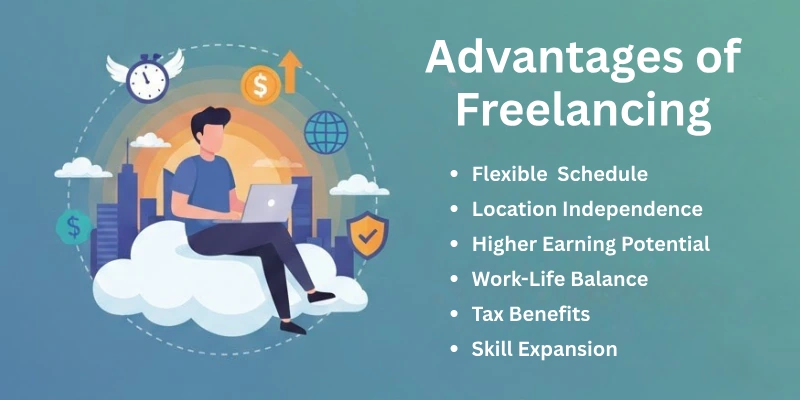
Here is the list of the benefits of freelancing:
- Work From Anywhere With Connectivity
- You’re the Boss
- Flexible Work Hours
- Control over Jobs and Clients
- Unlimited Income Growth
- Diverse Projects
- Expansive Networking Opportunities
- Access to Global Jobs
- Tax Benefits
- Skill Expansion
- Increased Personal Development
- Interest-Led Career-Building
Let’s dig in!
1. Work From Anywhere With Connectivity
- Freelancers can work from anywhere with an internet connection, providing unparalleled flexibility.
- This means they can avoid long commutes and accommodate personal commitments easily.
- They have the freedom to create a comfortable workspace tailored to their preferences.
2. You’re the Boss
- Freelancers have complete control over their careers, making decisions about projects and workload.
- They can set their own schedules, prioritizing tasks based on their needs.
- Being their own boss allows them to shape their work life according to their goals and aspirations.
3. Flexible Work Hours
- Freelancers enjoy the freedom to work at their preferred times, accommodating personal commitments effortlessly.
- This flexibility fosters a better work-life balance, reducing stress and improving overall well-being.
- Creating a schedule that suits them enhances productivity and satisfaction in their work.
4. Control over Jobs and Clients
- Freelancers can choose projects aligned with their interests and values.
- They select clients based on their preferences, fostering positive working relationships.
- Enjoying freedom in career choices allows for control and independence in their professional lives.
5. Unlimited Income Growth
- Freelancers have the potential for unlimited income growth as they keep all the profits from their work.
- There are no salary caps, allowing freelancers to earn as much as their skills and efforts permit.
- This financial incentive motivates freelancers to continuously improve and seek out high-paying opportunities.
6. Diverse Projects
- Freelancers have the opportunity to work on a variety of projects across different industries and niches.
- This diversity keeps work interesting and allows freelancers to expand their skills and knowledge.
- Working on diverse projects also opens up new opportunities for learning and professional growth.
7. Expansive Networking Opportunities
- Freelancing provides ample opportunities to network with professionals from various industries and backgrounds.
- Building a strong network can lead to collaborations, referrals, and new business opportunities.
- Networking also fosters personal and professional development by exposing freelancers to different perspectives and ideas.
8. Access to Global Jobs
- Freelancers can access job opportunities from around the world, transcending geographical boundaries.
- This global reach expands the pool of potential clients and projects, increasing earning potential.
- Access to global jobs also exposes freelancers to diverse cultures and markets, broadening their professional experience.
9. Tax Benefits
- Freelancers may be eligible for various tax deductions and credits, reducing their tax burden.
- Deductions can include expenses related to home office, equipment, and professional development.
- Taking advantage of tax benefits allows freelancers to maximize their earnings and financial stability.
10. Skill Expansion
- Freelancers have the opportunity to continuously expand their skill sets through hands-on experience and learning.
- Working on diverse projects exposes freelancers to new technologies, tools, and methodologies.
- This ongoing skill development enhances their expertise and marketability in the freelance marketplace.
11. Increased Personal Development
- Freelancing encourages personal growth by promoting autonomy, resilience, and adaptability.
- Overcoming challenges and managing projects independently fosters self-confidence and self-reliance.
- Personal development in freelancing extends beyond professional skills, encompassing aspects like time management and communication.
12. Interest-Led Career-Building
- Freelancers have the freedom to pursue projects and clients aligned with their passions and interests.
- This interest-led approach to career-building fosters greater job satisfaction and fulfillment.
- Building a career around one’s interests also increases motivation and commitment to long-term success.
Disadvantages of Freelancing
While freelancing gives you freedom and options, it also has its own challenges.
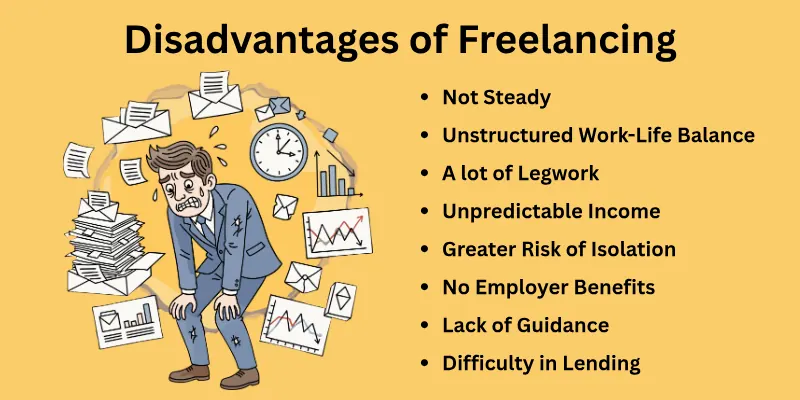
So, here is the list of all the downsides of freelancing:
- Not Steady or Reliable Workloads
- Unstructured Work-Life Balance
- A lot of Legwork
- Unpredictable Income
- Greater Risk of Isolation
- No Employer Benefits
- Lack of Readily Available Mentorships and Guidance
- Unstructured Career Advancement Opportunities
- Risk of Working With Difficult Customers Who Won’t Pay
- Difficulty in Lending
Let’s cover all the freelancing cons in detail.
1. Not Steady or Reliable Workloads
- The workloads of freelancers can vary, which can result in irregular income.
- This instability may lead to anxiety about future plans and costs.
- So, planning and careful budgeting are necessary for managing unexpected workloads.
2. Unstructured Work-Life Balance
- Keeping a good work-life balance is a common challenge for freelancers.
- Without clear boundaries, they may find themselves working long hours or feeling guilty when taking breaks.
- Routines and boundaries must be established in order to avoid stress and preserve wellbeing.
3. A lot of Legwork
- Freelancers are responsible for finding and securing their own clients and projects.
- This involves extensive networking, marketing, and self-promotion efforts.
- The process of finding work can be time-consuming and competitive, requiring persistence and patience.
4. Unpredictable Income
- The income of freelancers is unpredictable .
- This uncertainty gets heightened by fluctuations in project availability and client demand.
- Financial planning and budgeting are essential for surviving hard times and efficiently handling cash flow.
5. Greater Risk of Isolation
- Isolation and loneliness are common among freelancers because they frequently work alone.
- Motivation and mental health may be impacted by the lack of social interaction.
- Feelings of loneliness can be lessened by actively seeking out social connections—both online and offline.
6. No Employer Benefits
- Freelancers do not receive traditional employee benefits such as health insurance, retirement plans, or paid time off.
- They are responsible for sourcing and funding their own benefits, which can be costly and complex.
- Without employer-sponsored benefits, freelancers must prioritize financial planning to safeguard their well-being.
7. Lack of Readily Available Mentorships and Guidance
- Freelancers may lack access to mentorship and guidance typically provided by employers.
- This can hinder professional development and growth opportunities.
- Seeking out mentorship through networking can help fill this gap and provide valuable support.
8. Unstructured Career Advancement Opportunities
- Freelancers may find it challenging to advance their careers in a structured manner.
- Traditional paths for career advancement, such as promotions or performance reviews, are often absent.
- A successful freelancing profession demands strategic preparation and aggressive self-development.
9. Risk of Working With Difficult Customers Who Won’t Pay
- Freelancers face the risk of encountering clients who refuse to pay for services rendered.
- Disputes over payment can lead to financial losses and legal headaches.
- This risk can be reduced by implementing clear contracts and payment terms and thoroughly evaluating clients.
10. Difficulty in Lending
- Freelancers may find it hard to borrow money for things like a home or a car because their income can vary.
- Banks might see freelancers as riskier borrowers, making loan approval more challenging.
- Keeping thorough financial records and building a strong credit history can help freelancers improve their chances of getting loans.
Conclusion
In this article, we talked about the advantages and disadvantages of freelancing. It’s like having your own business, where you can choose your projects, work from anywhere, and be your own boss.
But it also means you might have to find your own clients, manage your time well, and not get paid if you don’t work. So, freelancing can be a great fit for some people, but it’s important to weigh the pros and cons before you decide.
FAQs
Here are the most commonly asked questions related to the advantages and disadvantages of doing freelancing:
Freelancing is being self-employed and working on projects for different clients, rather than a single employer.
Freelancing offers flexibility, control over work, and the potential for higher income. It can also cater to individuals seeking specific work-life balance.
Upwork, Fiverr, and Freelancer.com are popular platforms, but many others exist depending on your field.
Freelancing often comes with income instability, requires self-discipline, and lacks benefits like health insurance typically offered by traditional jobs.
While widely used, Freelancer.com is sometimes criticized for high competition and potentially lower project rates.
For businesses, freelancers offer access to specialized skills, cost-effectiveness, and scalability.
Freelancing is a legitimate work option, but like any field, there can be scams. Be cautious and use reputable platforms and practices.
It depends on individual preferences and priorities. Freelancing offers flexibility and control, but traditional jobs provide stability and benefits.






- Be Respectful
- Stay Relevant
- Stay Positive
- True Feedback
- Encourage Discussion
- Avoid Spamming
- No Fake News
- Don't Copy-Paste
- No Personal Attacks
- Be Respectful
- Stay Relevant
- Stay Positive
- True Feedback
- Encourage Discussion
- Avoid Spamming
- No Fake News
- Don't Copy-Paste
- No Personal Attacks
