Pros and Cons of Part-Time Job: Detailed Guide
Published: 21 Dec 2025
A recent study found that more than 70% of people working in the world do part-time work at some point in their lives. As freedom becomes more important in today’s job market, this trend is likely to keep going up. But because of the rise in part-time jobs, there are some things to think about.
This article will discuss the advantages and disadvantages of part-time job so that you can decide if this is the right type of work for you.
Advantages of Part-Time Job
Part-time jobs offer a variety of advantages that can make them a great fit for many people.
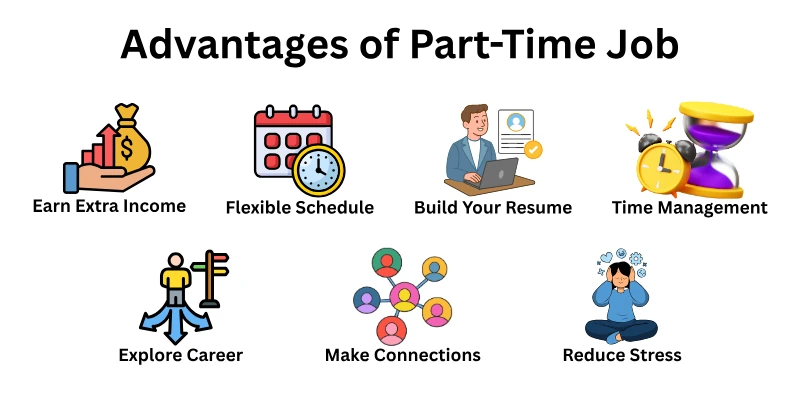
Here’s a quick rundown of all the benefits of a part-time job:
- Earn Extra Income
- Flexible Schedule
- Develop Valuable Skills
- Build Your Resume
- Network and Make Connections
- Gain Independence
- Improve Time Management Skills
- Explore Career Options
- Maintain a Work-Life Balance
- Reduce Stress
Now, let’s cover all the above-mentioned pros of part-time jobs in detail.
1. Earn Extra Income
With a part-time job, you can directly make more money. Part-time work can help you reach your financial goals, whether they are for a specific reason, like a dream trip, or just to have more money to spend. It can also be helpful for covering everyday expenses or unexpected costs.
2. Flexible Schedule
Many part-time jobs let you choose your own hours, unlike full-time jobs that have set hours. This gives you the freedom to set your own work hours around other things you have to do, like school, family, or even another job. This kind of flexibility is great for students, youngsters, and people who are always on the go.
3. Develop Valuable Skills
Part-time work is a great way to get new skills and real-world experience that you can use in your future job. These skills can make you a better candidate for full-time jobs, whether they’re in customer service, data entry, or administration.
4. Build Your Resume
Even part-time employment can help boost your resume. It indicates work experience, responsibility, and dedication to professional development. Listing relevant talents learned while working part-time will help you stand out to potential employers.
5. Network and Make Connections
Working part-time can help you build your professional network by introducing you to colleagues, bosses, and even clients. These contacts can be quite useful for learning about new work prospects and gaining recommendations for future positions.
6. Gain Independence
By giving you the chance to make your own money, a part-time job can help you feel more independent. This can give people a lot of power, especially young adults or people who depend on other people for money.
7. Improve Time Management Skills
Time management skills are very important if you want to balance work with other things like your personal or educational life. Having a part-time job can help you improve these skills by forcing you to set priorities, make good schedules, and meet goals quickly.
8. Explore Career Options
Before committing to a full-time job, part-time work is a great way to try out different career paths. By trying out different areas, you can find out what you’re interested in and which ones fit your skills and goals the best. With this “test-drive” method, you can make smart choices about your future work without the risk.
9. Maintain a Work-Life Balance
Working part-time lets you keep your personal and professional lives in good order. Less time spent at work means more time for hobbies, spending time with family and friends. You can avoid burnout and improve your general health by finding this balance.
10. Reduce Stress
Surprisingly, working part-time can help you feel less stressed. Having a part-time job can give you a feeling of purpose and accomplishment. And it can also help you forget about your everyday problems. More than that, having extra money can help you feel better by reducing financial stress.
Disadvantages of Part Time Job
While part-time jobs offer many advantages, there are also some drawbacks to consider.
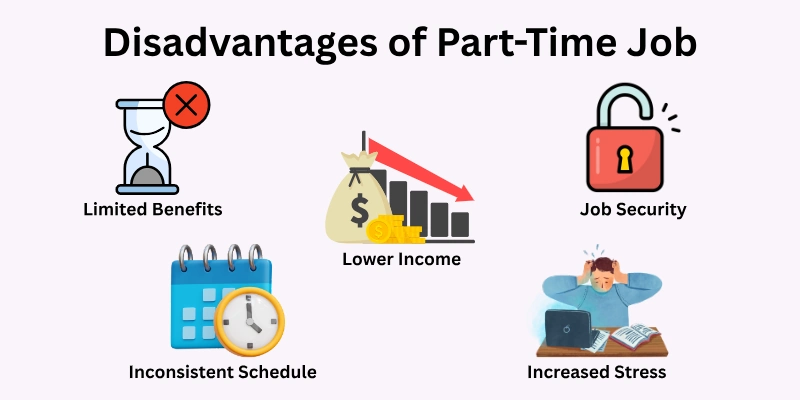
Here’s a list of some of the main disadvantages of having a part time job:
- Lower Income
- Limited Benefits
- Job Security
- Inconsistent Schedule
- Increased Stress
Let us cover all the cons of a part time job in detail.
1. Lower Income
People who work part-time have fewer hours, they naturally make less money than people who work full-time. This can make it hard to save a lot of money or pay for big purchases. If having enough money is very important to you, you might need to look for other ways to make money.
2. Limited Benefits
Many part-time jobs offer limited or no benefits compared to full-time positions. This may include health insurance, paid time off (sick leave, vacation), retirement plans, or other employer-sponsored benefits. Without these benefits, you need to manage your health expenses independently and plan for vacations or sick leave using unpaid time off.
3. Job Security
Most of the time, part-time jobs are less secure than full-time jobs. This means that you may be more likely to be fired or have your hours cut during economic downturns or when a company is reorganizing. If keeping your job is very important to you, a full-time job might be a better option.
4. Inconsistent Schedule
Part-time work often gives you more freedom, but some plans can be hard to stick to. This could mean different hours from week to week, working nights or weekends, or having to change your plan at the last minute. An inconsistent schedule can make it difficult to maintain a personal life routine.
5. Increased Stress
Managing multiple commitments, such as work, school, or family responsibilities, can be challenging, leading to feelings of time pressure and fatigue. The potential for inconsistent schedules or lack of job security can also contribute to stress. Also, combining a part-time employment with other responsibilities can make it difficult to find time for relaxation and de-stressing activities.
Facts about Part Time Job
- Lots of people in the U.S. have part-time jobs – over 26 million!
- Young adults are especially likely to work part-time, almost one out of four 16-24 year olds do.
- More women work part-time than men, nearly three times as many in the U.S.
- Most part-timers actually choose to work part-time, around 7 out of 10 in the U.S. prefer it.
- Restaurants and cafes hire a lot of part-timers, nearly a third of all their workers!
- The food industry loves part-timers too, over a third of their staff work part-time.
- Part-time jobs might be flexible, but the average worker puts in about 20 hours a week.
- Believe it or not, some part-time jobs pay really well! Part-time computer programmers can make over $100,000 a year!
- Some countries have way more part-time workers than others. In the Netherlands, over a third of people have part-time jobs!
- Moms with young kids often work part-time. In Europe, more than half of moms with little ones choose part-time work.
So, is a Part-Time Job Right for You?
This article has explored the many advantages and disadvantages of part-time jobs. We’ve seen how they can offer flexibility, extra income, and valuable skills development, while also acknowledging potential drawbacks like lower income, limited benefits, and less time for other commitments.
Ultimately, whether a part-time employment is good for you is determined by your circumstances and goals. Before making a decision, think about your financial needs and desired work-life balance.
FAQs
Here are some of the most commonly asked questions related to the advantages and disadvantages of part time job:
Temporary Work:
- Pros: Gain experience, flexible hours, good for career changers.
- Cons: No job security, lower income, limited benefits.
Job Descriptions:
- Pros: Helps you understand the role and expectations.
- Cons: Not always accurate, might not capture everything.
The major cons of working 9 to 5 are: Can be inflexible, doesn’t suit everyone’s schedule.
Disadvantages of working long hours are: Burnout, less time for personal life, health problems (stress, fatigue).
Yes, it can be bad! It leads to stress, exhaustion, and hurts your well-being. Take breaks and maintain a healthy balance.
Not many! Smart work focuses on efficiency, but sometimes complex tasks require dedicated effort alongside clever strategies.






- Be Respectful
- Stay Relevant
- Stay Positive
- True Feedback
- Encourage Discussion
- Avoid Spamming
- No Fake News
- Don't Copy-Paste
- No Personal Attacks
- Be Respectful
- Stay Relevant
- Stay Positive
- True Feedback
- Encourage Discussion
- Avoid Spamming
- No Fake News
- Don't Copy-Paste
- No Personal Attacks
