Pros and Cons of Self-Learning: Take Control of Your Education!
Published: 30 Nov 2025
Did you know that in today’s world, lifelong learning is more important than ever?
Whether you’re looking to upskill for a new job or simply want to explore a personal interest, self-directed learning is a powerful tool that can help you achieve your goals.
This article will delve into the advantages and disadvantages of self-directed learning, so you can decide if it’s the right approach for you.
Advantages of Self-Directed Learning
In today’s dynamic world, self-directed learning empowers you to take control of your education and become a master of your own knowledge domain.
This approach unlocks a lot of benefits, allowing you to create a learning experience that perfectly relates with your goals and interests.
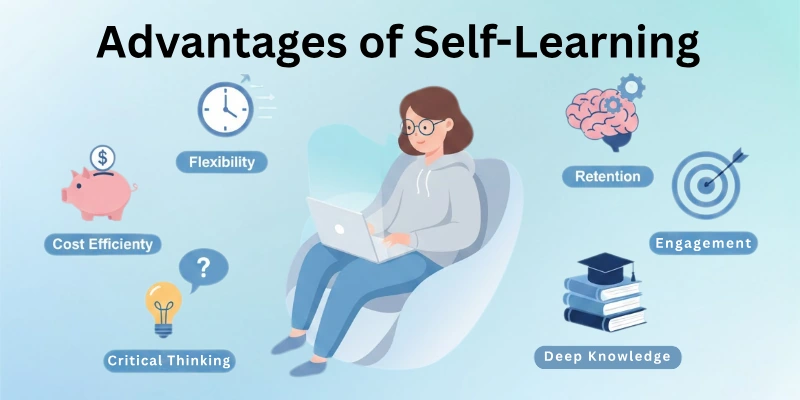
Here’s a comprehensive list of all the benefits of self learning:
- Increased Flexibility and Individualized Pace
- Enhanced Motivation and Engagement
- Improved Time Management Skills
- Deeper Knowledge and Understanding
- Development of Critical Thinking Skills
- Boosted Confidence
- Lifelong Learning Skills
- Potential Cost Savings
- Catering to Different Learning Styles
- Time Efficiency
- Deeper Retention of Knowledge
- Cultivation of Curiosity
Let’s learn all the pros of self-directed learning in detail.
1. Increased Flexibility and Individualized Pace
Self-directed learning frees you from the limitations of a set routine. You may personalize your learning experience to your lifestyle, studying at a speed that is comfortable and allows for maximum comprehension.
2. Enhanced Motivation and Engagement
In charge of your own learning makes you more likely to be genuinely interested and invested in the subject. Choosing things that interest you allows you to be more engaged and motivated.
3. Improved Time Management Skills
Self-directed learning helps you learn how to use your time well. You’ll learn how to make goals that are achievable, organize your study time well, and develop the self-control to follow through on them.
4. Deeper Knowledge and Understanding
When you’re in a traditional classroom, you’re usually limited to a set program. Self-directed learning, on the other hand, lets you learn more about things that interest you, which helps you understand them better overall.
5. Development of Critical Thinking Skills
The process of self-directed learning makes you think about the things you read and see. Your skills will improve as you learn to judge the reliability of sources, come to your own decisions, and solve problems on your own.
6. Boosted Confidence
Successfully mastering new skills or knowledge on your own is a rewarding experience. Self-directed learning fosters a sense of accomplishment, boosting your confidence in your abilities and propelling you to tackle future challenges.
7. Lifelong Learning Skills
There is always more to learn, and self-directed learning gives you the skills and attitude to keep learning throughout your life. You will learn the skills and gain the drive to keep looking for new information and grow your knowledge.
8. Potential Cost Savings
Formal education can be expensive. Self-directed learning, however, can be a more cost-effective way to gain new knowledge and skills. There’s a wealth of free or low-cost learning resources available online and in libraries.
9. Catering to Different Learning Styles
Self-directed learning allows you to experiment with a variety of learning methods and materials that are tailored to your individual learning style. Whether you’re a visual learner who enjoys watching videos, an auditory learner who learns best through lectures, or a physical student who prefers hands-on activities, you can customize your own learning method.
10. Time Efficiency
Self-directed learning allows you to focus on the areas that require the most attention. You can bypass topics you already understand and dedicate more time to concepts you find challenging. This eliminates wasted time and allows you to learn more efficiently.
11. Deeper Retention of Knowledge
Self-directed learning frequently leads to greater knowledge retention. When you actively participate in the learning process, such as creating goals, gathering information, and applying your knowledge practically, you are more likely to retain information over time.
12. Cultivation of Curiosity
Self-directed learning creates a passion for learning and a sense of curiosity. When you have control over your learning journey, you are more likely to be motivated by a real desire to study new topics and go deeply into those that pique your interest. This built-in motivation generates a lifetime love of learning.
Disadvantages of Self-Directed Learning
While self-directed learning offers a wealth of advantages, it’s important to acknowledge that it also comes with some challenges.
The freedom and flexibility of this approach can be a double-edged sword, and some learners may find themselves struggling with it.
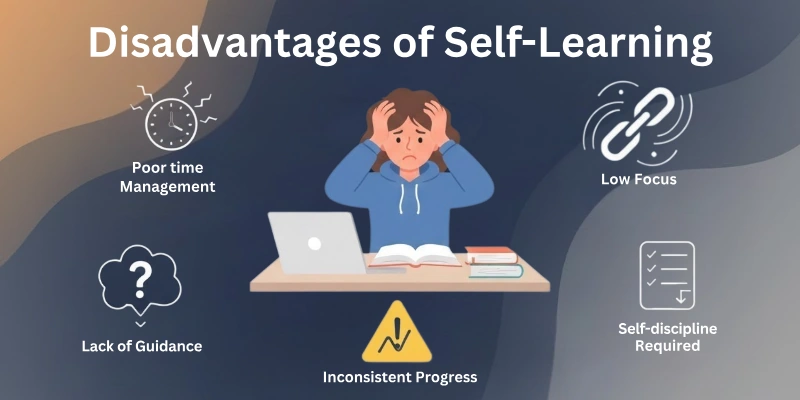
So here is the list of all the drawbacks of self learning:
- Lack of Structure and Guidance
- Time Management Difficulties
- Motivation and Focus Issues
- Difficulties with Assessment
- Limited Interaction and Feedback
- Potential for Knowledge Gaps
- Information Overload and Source Evaluation
- Technological Challenges
- Learning Style Mismatch
- Potential for Isolation
Let’s learn all the cons of self-directed learning in detail.
1. Lack of Structure and Guidance
There isn’t as much structure and clear direction in self-directed learning settings as there is in a traditional classroom. This can be especially hard for students who learn best with a set curriculum and demand regular comments from their teachers.
2. Time Management Difficulties
The freedom of self-directed learning comes with the responsibility of managing your own time effectively. Without the external structure of a classroom schedule, students may find it hard to stay on track, set priorities, and study enough.
3. Motivation and Focus Issues
Staying motivated and focused on your learning goals can be a hurdle in a self-directed learning environment. Distractions, competing priorities, and the absence of external accountability can make it difficult to maintain consistent effort.
4. Difficulties with Assessment
In self-directed learning, it can be hard to keep track of your success and see where you need to improve. Standardized tests and teacher feedback can help you figure out how well you understand the subject, but they aren’t always available in self-learning.
5. Limited Interaction and Feedback
Self-directed learning often means studying alone, which can make it harder to make friends and learn from each other. If you don’t get regular feedback from teachers or classmates, it can be hard to find and fill in information gaps.
6. Potential for Knowledge Gaps
As a result of not having a teacher to guide them, students may miss important information or get confused while they are learning. This can leave you with gaps in your information and make it harder for you to fully grasp the subject.
7. Information Overload and Source Evaluation
It can be hard to handle the huge amount of information that is available online. In self-directed learning, it can be hard to tell the difference between dependable sources and unreliable ones. To figure out if information is correct and reliable, you need to be able to think critically and find your way around the complicated world of the internet.
8. Technological Challenges
Self-directed learning often relies on technology for accessing resources and completing learning activities. Learners may face challenges due to limited access to computers, reliable internet connections, or the necessary software and tools.
9. Learning Style Mismatch
Self-directed learning may not be suitable for all learning styles. Learners who thrive on the structure and interaction of a traditional classroom setting may find it challenging to adapt to the independent and self-paced nature of self-directed learning.
10. Potential for Isolation
Because self-directed learning is done alone, it can make people feel also alone, especially those who want to connect with others and work together. And mainly not having a learning group can make you less motivated and less interested in what you’re doing.
Conclusion
In this article, we have comprehensively explored both the advantages and disadvantages of self-directed learning.
There are some problems that might come up, but there are also many benefits to self-directed learning. You can take charge of your education, make your learning journey unique, and develop a love of learning that will last a lifetime with this method.
Self-directed learning is a great way to learn new things that fit your schedule and interests. To be as successful as possible, though, you should be aware of the possible problems and come up with ways to deal with them.
FAqs
Here are some of the commonly asked questions related to the pros and cons of self-learning:
Advantages of SDL:
- Learner-driven: You choose what, how, and when you learn (topics, pace, schedule).
- Boosts independence: Develops time management, critical thinking, and self-motivation.
- Deeper understanding: You explore topics that interest you, leading to better retention.
Disadvantages of SDL:
- Self-discipline needed: Requires strong motivation and time management skills to stay on track.
- Information overload: Finding reliable sources and avoiding bad information can be challenging.
- Limited interaction: Less opportunity for feedback and discussion compared to teacher-led classes.
Positive effects of self-directed learning:
- Increased self-motivation
- Improved time management skills
- Enhanced critical thinking abilities
- Tailored learning experience
- Encourages lifelong learning
Individual learning, while fostering independence, can lack the benefits of collaboration and social interaction. Students miss out on peer-to-peer learning, group discussions, and the opportunity to learn from different perspectives.
Here are 5 disadvantages of online learning:
- Lack of Face-to-Face Interaction
- Difficulty Staying Motivated
- Limited Access to Resources and Support
- Technical Difficulties
- Not Suitable for All Subjects or Learning Styles
Self-Assessment disadvantages:
- Over/Underestimation
- Lack of objectivity
- Limited feedback






- Be Respectful
- Stay Relevant
- Stay Positive
- True Feedback
- Encourage Discussion
- Avoid Spamming
- No Fake News
- Don't Copy-Paste
- No Personal Attacks
- Be Respectful
- Stay Relevant
- Stay Positive
- True Feedback
- Encourage Discussion
- Avoid Spamming
- No Fake News
- Don't Copy-Paste
- No Personal Attacks
