Pros and Cons of Email: Are You Aware of the Risks?
Published: 31 Jan 2026
Guys, do you know 4.1 billion people now use email worldwide, and despite the rise of other communication channels, email remains a crucial tool? This shows that emails are very advantageous to us.
However, on the flip side, men tend to check their email an average of 20 times a day, spending a total of 5.4 hours daily on email-related activities. This clearly highlights the downside of relying heavily on email.
So, balancing the advantages and disadvantages of email can help us maintain a better usage of it, like when it is helpful for us to use it and when it is better to avoid it.
So guys, without wasting time, let’s dig into the article to cover all the merits and de-merits of using electronic mail.
Email Advantages
Email is an important part of modern contact in this digital age. It has many benefits that make correspondence easier and connections stronger.
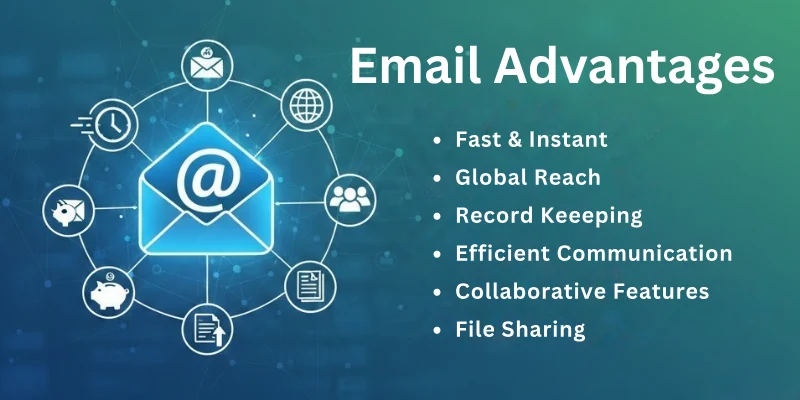
Here are some of the best pros of email:
- Speed & Efficiency
- Organization & Record Keeping
- Professional Communication
- Accessibility & Cost-Effectiveness
- Versatility & File Sharing
- Asynchronous Communication
- Targeted Communication
- Global Reach
- Broadcasting & Marketing
- Collaborative Features
- Scheduling & Reminders
- Scalability & Adaptability
Let’s cover this list of all the advantages of electronic mail in detail.
1. Speed & Efficiency
- Emails travel through the internet very quickly, reaching the recipient almost instantly.
- You can send messages to many people at once, saving time compared to sending individual letters.
- It’s easy to compose, edit, and send emails with just a few clicks, making communication faster and more efficient.
2. Organization & Record Keeping
- Emails can be sorted into folders, helping you keep your inbox neat and tidy.
- You can search through past emails to find important information or conversations.
- Emails serve as a digital record of communication, making it easy to reference previous discussions or agreements.
3. Professional Communication
- Emails provide a formal and professional way to communicate in a business or academic setting.
- You can customize your email with professional formatting, signatures, and branding.
- It’s easy to attach documents or links to provide additional information in a professional manner.
4. Accessibility & Cost-Effectiveness
- You can access your emails from any device with internet access, whether it’s a computer, smartphone, or tablet.
- Sending emails is usually free, eliminating the need for postage stamps and paper envelopes.
- It saves money on printing and distribution costs, making it a cost-effective communication option.
5. Versatility & File Sharing
- Emails allow you to send not only text but also images, documents, and multimedia files.
- You can share large files with colleagues or friends by attaching them to an email.
- It’s convenient for collaborating on projects or sharing important documents with others.
6. Asynchronous Communication
- Emails allow you to communicate with others even if they are in different time zones or unavailable.
- You can send messages at any time, and the recipient can respond when it’s convenient for them.
- It enables flexible communication without the need for immediate responses.
7. Targeted Communication
- You can send personalized emails to specific individuals or groups, tailoring your message to their interests or needs.
- It helps in reaching the right audience with relevant information, increasing the effectiveness of communication.
- Targeted emails can lead to higher engagement and response rates compared to mass communication.
8. Global Reach
- Emails can be sent to people anywhere in the world, allowing you to connect with individuals or organizations globally.
- It facilitates cross-border communication without the limitations of distance or time zones.
- You can expand your network and reach new markets internationally through email communication.
9. Broadcasting & Marketing
- Emails are an effective tool for broadcasting announcements, promotions, or newsletters to a large audience.
- You can reach potential customers or subscribers directly in their inbox, increasing brand visibility.
- Email marketing campaigns can be tracked and analyzed to measure engagement and effectiveness.
10. Collaborative Features
- Email platforms often offer collaboration tools such as shared calendars, task lists, and document editing.
- Multiple users can work together on projects or schedules by exchanging emails and sharing information.
- It promotes teamwork and enhances productivity by facilitating communication and coordination among team members.
11. Scheduling & Reminders
- You can use emails to schedule meetings, appointments, or events with others.
- Reminders can be set up to notify recipients about upcoming deadlines or tasks.
- It helps in managing time effectively and staying organized by keeping track of important dates and commitments.
12. Scalability & Adaptability
- Emails can be scaled to accommodate the needs of individuals, small businesses, or large corporations.
- Email platforms offer customizable features and options to suit different preferences and requirements.
- It adapts to evolving technology and communication trends, remaining a versatile and indispensable tool in various domains.
Email Disadvantages
While email has revolutionized communication but it’s not without its drawbacks.
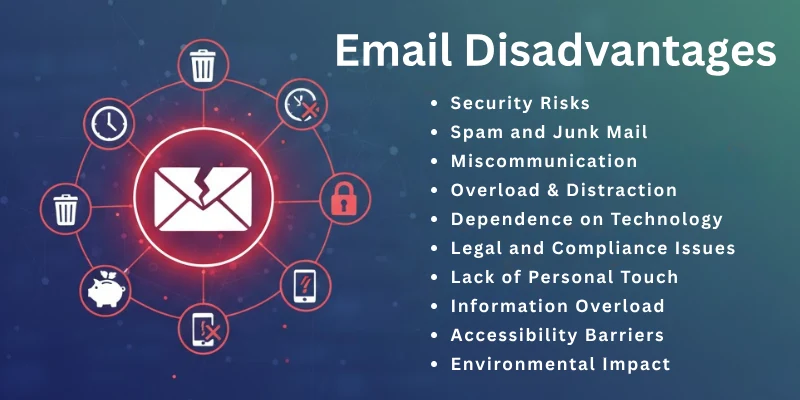
This section will explore some of the potential problems of email, providing insight into situations where alternative communication methods might be preferable.
So, here is the list of all the cons fo email:
- Security Risks
- Spam and Junk Mail
- Miscommunication
- Overload & Distraction
- Dependence on Technology
- Legal and Compliance Issues
- Lack of Personal Touch
- Information Overload
- Accessibility Barriers
- Environmental Impact
Let’s cover all the disadvantages of email in detail.
1. Security Risks
- Emails can be vulnerable to hacking, phishing, or malware attacks, compromising sensitive information.
- Lack of encryption can lead to interception of confidential data during transmission.
- Users may fall victim to scams or fraudulent emails, resulting in financial or identity theft.
2. Spam and Junk Mail
- Many people get a lot of emails they didn’t ask for, which can make it hard to find important messages.
- Spam emails often contain malicious links or content, posing security risks to recipients.
- Managing spam requires time and effort, potentially leading to missed or overlooked legitimate emails.
3. Miscommunication
- Tone, context, and emotions can be misunderstood or misinterpreted in written communication, leading to conflicts or confusion.
- Lack of non-verbal cues such as facial expressions and body language may result in communication breakdowns.
- Complex or sensitive topics may be difficult to discuss effectively via email, requiring face-to-face or phone conversations.
4. Overload & Distraction
- Constant email notifications can disrupt workflow and productivity, leading to multitasking and reduced focus.
- Managing a large volume of emails can be overwhelming, causing stress and anxiety.
- Employees may feel pressure to respond to emails promptly, leading to burnout or work-life imbalance.
5. Dependence on Technology
- Reliance on email for communication may hinder face-to-face interactions and interpersonal relationships.
- Technical issues such as server outages or connectivity problems can disrupt email access and functionality.
- Users may experience difficulties accessing or retrieving emails due to software compatibility issues or device failures.
6. Legal and Compliance Issues
- Email communications may be subject to legal regulations and compliance requirements, such as data protection laws.
- Failure to adhere to privacy policies or industry regulations can result in fines, penalties, or legal consequences.
- Retention and archiving of emails for regulatory compliance purposes can be cumbersome and resource-intensive.
7. Lack of Personal Touch
- Email doesn’t have the same human touch and warmth as talking to someone in person or writing a letter by hand.
- It can be hard to get to know someone and build trust through written messages alone, especially in business situations.
- In email conversations, it’s possible to miss important details, which can hurt the quality of relationships.
8. Information Overload
- Excessive email communication can lead to information overload, making it difficult to prioritize and digest content.
- Important messages may get buried or overlooked amidst a sea of emails, leading to missed opportunities or deadlines.
- Filtering through irrelevant or redundant emails consumes time and mental energy, detracting from productivity.
9. Accessibility Barriers
- Not everyone has access to reliable internet connectivity or digital devices required for sending and receiving emails.
- Individuals with disabilities may face accessibility challenges in accessing and interacting with email interfaces.
- Language barriers or technological literacy issues may limit email usage and effectiveness in diverse populations.
10. Environmental Impact
- Digital infrastructure required for email communication consumes energy and contributes to carbon emissions.
- Manufacturing, disposal, and recycling of electronic devices used for email access have environmental implications.
- Excessive digital consumption associated with email usage contributes to electronic waste generation and resource depletion.
12 Email Alternatives & Competitors For Better Business Communication
Here are 12 email alternatives you must try:
- ProofHub
- Slack
- Hubspot CRM
- Google Hangouts
- Mail.com
- Yandex.Mail
- Zoho Mail
- Outlook.com
- Groove
- Skype
- Fastmail
- Yammer
Conclusion
This article has thoroughly explored the advantages and disadvantages of email. We’ve looked into various aspects of this widely used tool, ranging from how well it helps with conversation to the security risks it might pose.
Looking back, it’s clear that email has changed the way we connect, but it also has some problems. Yet, with proper management and awareness, its benefits can far outweigh its drawbacks in the modern digital landscape.
FAQs
Here are some of the most commonly asked questions related to the pros and cons of e-mail:
Here is the list of all email benefits:
- Fast and efficient communication
- Accessibility
- Organization and storage
- Cost-effective
- Flexibility
Here are some email disadvantages:
- Security concerns
- Information overload
- Miscommunication
- Addiction and distraction
- Environmental impact
Email remains essential for communication in personal and professional settings. It’s widely used for various purposes, including:
- Business communication
- Personal communication
- Marketing and advertising
- Education and learning
- News and updates
Yes, alternatives exist, each with its own advantages and disadvantages:
- Instant messaging
- Collaboration tools
- Social media
Follow these steps:
- Organize your inbox
- Be mindful of content and tone
- Use strong passwords and security measures
- Respond promptly and avoid misunderstandings
- Consider alternatives for specific situations





- Be Respectful
- Stay Relevant
- Stay Positive
- True Feedback
- Encourage Discussion
- Avoid Spamming
- No Fake News
- Don't Copy-Paste
- No Personal Attacks
- Be Respectful
- Stay Relevant
- Stay Positive
- True Feedback
- Encourage Discussion
- Avoid Spamming
- No Fake News
- Don't Copy-Paste
- No Personal Attacks
