Pros and Cons of Firewall: What You Should Know!
Published: 27 Jan 2026
A firewall is like a security guard for your computer or network. It watches over the traffic coming in and going out, deciding what’s allowed and what’s not based on rules you set. But like any tool, firewalls have their pros and cons.
In this article, we’ll look at both the advantages and disadvantages of firewalls to protect your digital world, so you can make informed decisions about your online safety.
Advantages of Firewall
Firewalls are like digital superheroes. Because – they protect your devices and networks from internet threats. They provide a variety of features to help keep your digital environment safe and secure.
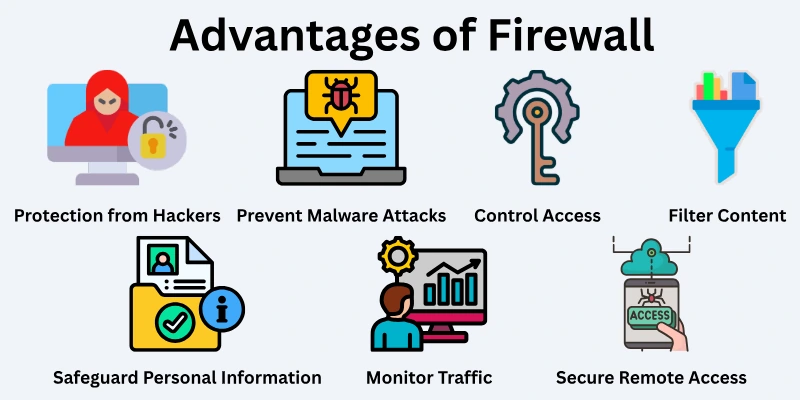
Here is the list of all the major pros of firewall usage:
- Protection from Hackers
- Prevent Malware Attacks
- Safeguard Personal Information
- Control Access
- Filter Content
- Monitor Traffic
- Secure Remote Access
Let us learn all the above advantages of using firewalls in detail.
1. Protection from Hackers
Firewalls protect your computer and network by putting up a wall between them. As data packets come in, they look at them and stop any behaviour that seems suspicious, which could be a sign of a hacker. So by keeping unauthorized users out, firewalls keep your data safe from harm.
2. Prevent Malware Attacks
One of the primary functions of a firewall is to prevent malware. They prevent viruses, worms, and Trojans from infecting your devices. It checks incoming data for known malware signatures and prevents dangerous stuff from entering your system.
3. Safeguard Personal Information
Firewalls play an important role in protecting your personal information. They protect your data from unauthorised access by limiting who can communicate with your computer or network. This means that even if someone gets logged into your network, they will be unable to access your important personal information.
4. Control Access
With a firewall in place, you have control over who can access your network. Firewalls allow you to set up rules and permissions that govern which users or devices can gain access to your data. This allows you to manage network traffic efficiently and effectively.
5. Filter Content
Firewalls are used to filter content and prevent access to inappropriate websites or applications. By implementing content filtering rules, you may prevent users on your network from viewing unsafe content. This is especially beneficial in educational or business contexts.
6. Monitor Traffic
Another benefit of firewalls is the ability to monitor network traffic in real time. They monitor logging the source, destination, and type of communication. This enables network administrators to detect and investigate any suspicious activities.
7. Secure Remote Access
Firewalls provide a safe gateway for remote users to connect to the network from outside places. Firewalls maintain the safety and security of remote access by encrypting data transmissions and authenticating users, thereby protecting critical information from interception or unauthorised access.
Disadvantages of Firewall
While firewalls offer significant protection , these firewalls also come with limitations that users should be aware of.
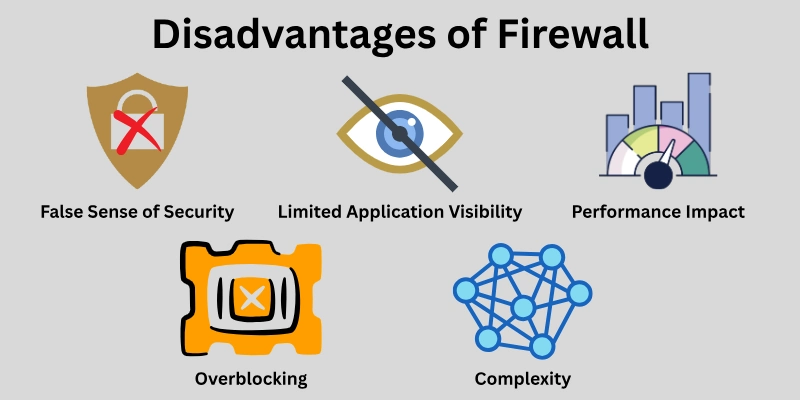
Here are some major cons of firewall listed:
- False Sense of Security
- Overblocking
- Performance Impact
- Complexity
- Limited Application Visibility
Now, let’s cover all the above mentioned drawbacks of using firewalls in detail.
1. False Sense of Security
Sometimes, firewalls make people feel too safe. They’re good at stopping some threats, but not all. People might think they’re totally protected because of the firewall, but that’s not true. They could still be at risk from other kinds of attacks.
2. Overblocking
Firewalls can block stuff they shouldn’t. They might stop you from getting to websites or using apps that are actually safe. This can cause problems and make it hard to do your work or use the internet like normal.
3. Performance Impact
Firewalls can slow things down. Because they check every bit of data, they can make your internet connection or computer work slower. This can be annoying, especially if you need things to be fast.
4. Complexity
The installation and operation of firewalls can be challenging. To get computers and networks to function properly, you need to have a broad understanding of both of these topics. The situation can be really confusing for those who are not professionals in the field.
5. Limited Application Visibility
Firewalls can’t always see everything that’s going on. They might not know what apps you’re using, just where the data is going. This can make it tricky to control exactly what’s happening on your network.
Conclusion
In this article we have covered all the advantages and disadvantages of firewalls in detail. We started by understanding what they are, then talked about the good stuff they do, like keeping out hackers and viruses.
But we also talked about their limitations, like sometimes slowing down your internet and not catching every threat. Remember, while firewalls help, they’re just one part of staying safe online. Keep learning and stay aware of new ways to protect yourself!
FAQs
Here are some of the commonly asked questions related to the advantages and disadvantages of firewall:
There are four types of firewalls:
- Packet filtering firewalls
- Circuit level gateway firewalls
- Application level gateway firewalls
- Stateful Multilayer Inspection firewalls
Yes! While antivirus protects against malware, a firewall controls incoming and outgoing traffic, adding an extra layer of security.
Slightly. Firewalls inspect traffic, which can take a fraction of a second, but it’s usually not noticeable.
Most firewalls allow you to create exceptions for specific programs, allowing them to communicate freely.
It depends on your firewall. Consult your firewall’s documentation or the device’s manual for specific instructions.





- Be Respectful
- Stay Relevant
- Stay Positive
- True Feedback
- Encourage Discussion
- Avoid Spamming
- No Fake News
- Don't Copy-Paste
- No Personal Attacks
- Be Respectful
- Stay Relevant
- Stay Positive
- True Feedback
- Encourage Discussion
- Avoid Spamming
- No Fake News
- Don't Copy-Paste
- No Personal Attacks
