Pros & Cons of Metropolitan Area Network (MAN)
Published: 12 Dec 2025
A Metropolitan Area Network (MAN) is like a big internet for a city or campus. It connects buildings so people can share things like files and printers. In this article, we’ll talk about the advantages and disadvantages of MAN.
We’ll explain how they help people work together in cities and campuses, but also what problems they can have.
Advantages of MAN
Metropolitan Area Networks offer numerous advantages for businesses, schools, and organizations in urban or campus settings.
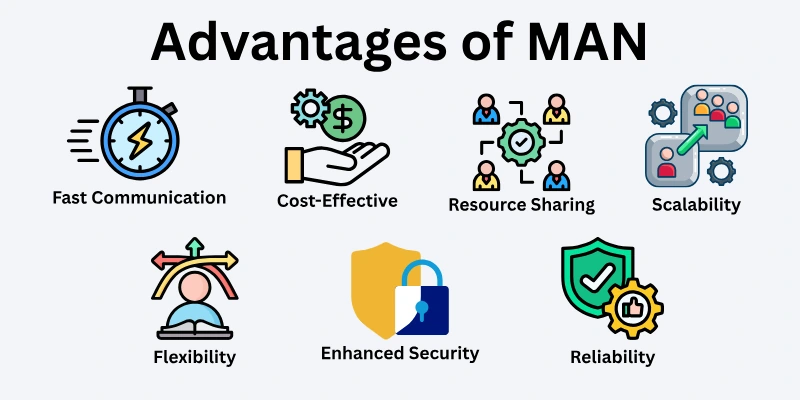
Here are the top 10 benefits of MAN networks:
- Fast Communication
- Cost-Effective
- Resource Sharing
- Centralized Management
- Improved Collaboration
- Scalability
- Reliability
- Enhanced Security
- Flexibility
- Local Connectivity
Let’s cover all the pros of MAN network in detail.
1. Fast Communication
MANs enable rapid communication between multiple locations. This allows messages and data to move at rapid speeds. Rapid communication promotes efficiency and productivity in businesses and organisations.
2. Cost-Effective
MANs provide cost-effective solutions by combining several networks into a single one. This unification dramatically decreases setup and maintenance costs. By joining resources such as internet connections and servers, MANs assist organisations with reducing recurring expenses.
3. Resource Sharing
MANs make resource sharing simple because printers, scanners, and servers can be accessed from multiple places. This accessibility encourages collaboration between individuals and departments. By centralising resources, MANs minimise the need for duplicating equipment in each location.
4. Centralized Management
MANs provide centralised management. This lets network administrators monitor all connected sites from a single location. This centralised control allows for effective network monitoring and remote troubleshooting of difficulties.
5. Improved Collaboration
MANs help teams and departments work together more effectively. Employees, regardless of their physical location, may efficiently collaborate on projects, increasing productivity and innovation. Communication tools such as video conferencing and instant messaging are widely available in it.
6. Scalability
Designed to grow with organizational needs, MANs offer scalability and flexibility. As businesses expand, MANs can accommodate the increased demand for network resources and connectivity. This scalability ensures that organizations can adapt to changing requirements without any difficulty.
7. Enhanced Security
MANs prioritise increased security measures. This is everything done to protect your sensitive information and prevent unauthorised access. With strong encryption methods and firewalls in place, MANs ensure that data is secure throughout transit.
8. Local Connectivity
MANs provide quick and dependable local connectivity within a defined geographic area. Employees, students, and departments in the same city or campus can readily share resources and information without the need for external networks. This local connectivity promotes a sense of community and cooperation.
Disadvantages of MAN
While Metropolitan Area Networks (MANs) offer several benefits, they also come with certain drawbacks.
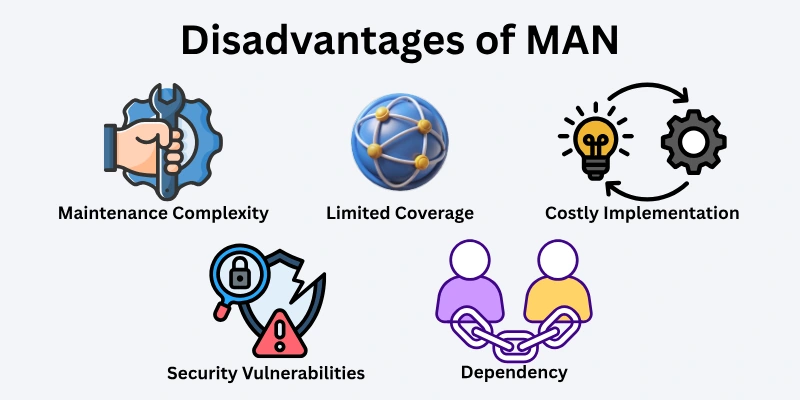
Here is the list of all the major cons of MAN networks:
- Limited Coverage
- Costly Implementation
- Maintenance Complexity
- Security Vulnerabilities
- Dependency on Infrastructure
Let us cover all the above mentioned disadvantages of metropolitan area networks in detail.
1. Limited Coverage
MANs usually cover a smaller geographical region than Wide region Networks (WANs). This can limit connectivity possibilities for organisations with large operations. Businesses that operate in different cities or regions may find MANs insufficient for their networking needs.
2. Costly Implementation
Installing a MAN network might be costly. Especially for organisations that have several sites and require considerable infrastructure and equipment. The initial investment in hardware, software, and professional services for installation and configuration can be rather costly.
3. Maintenance Complexity
Maintaining and operating a MAN network necessitates specialised expertise and resources. Regular maintenance duties like troubleshooting, updates, and patch management can be difficult and time-consuming. Organisations may need dedicated workers to guarantee the MAN runs smoothly.
4. Security Vulnerabilities
MANs are exposed to security breaches and cyberattacks, just like any other network infrastructure. Without sufficient security measures, sensitive data transmitted across the network may be hacked or corrupt. Hackers could take advantage of weaknesses in MANs to get unauthorised access to your information.
5. Dependency on Infrastructure
The stability of a MAN network is strongly reliant on the underlying infrastructure, which includes cables, routers, and switches. Any disruptions or breakdowns in the infrastructure might result in downtime and service outages, harming corporate operations.
Conclusion
So, in this article, we have explored both the advantages and disadvantages of MAN networks. We’ve seen how MANs enable the connection of devices within a university or a small city without relying on the internet. However, we’ve also noted some limitations, such as MANs being less suitable for larger cities or for sharing resources with other cities.
FAQs
Here are some of the most commonly asked questions related to the advantages and disadvantages of MAN networks:






- Be Respectful
- Stay Relevant
- Stay Positive
- True Feedback
- Encourage Discussion
- Avoid Spamming
- No Fake News
- Don't Copy-Paste
- No Personal Attacks
- Be Respectful
- Stay Relevant
- Stay Positive
- True Feedback
- Encourage Discussion
- Avoid Spamming
- No Fake News
- Don't Copy-Paste
- No Personal Attacks
