Pros & Cons of Manual Data Entry Services: Outsource or Automate?
Published: 24 Oct 2025
Did you know the human brain can type up to 80 words per minute? While impressive, even the fastest typists can’t compete with machines when it comes to large amounts of data. This is where manual data entry services come in.
In this article, we’ll explore the advantages and disadvantages of manual data entry services.
What Is Manual Data Entry?
Manual data entry is the process of manually inputting information into a computer system or database. It involves a person typing, copying, or transcribing data from one source to another, such as:
- Paper forms and documents
- Handwritten notes
- Audio recordings
- Images
- Other digital files
While automation is increasingly used for data entry but manual entry services are still used in various scenarios, and understanding its pros and cons can be crucial for businesses and individuals dealing with data management.
Advantages of Manual Data Entry Services
Manual data entry services are very important for making sure that data is handled correctly, securely, and with flexibility. Even though technology has improved, some parts of data management will always need a human touch.
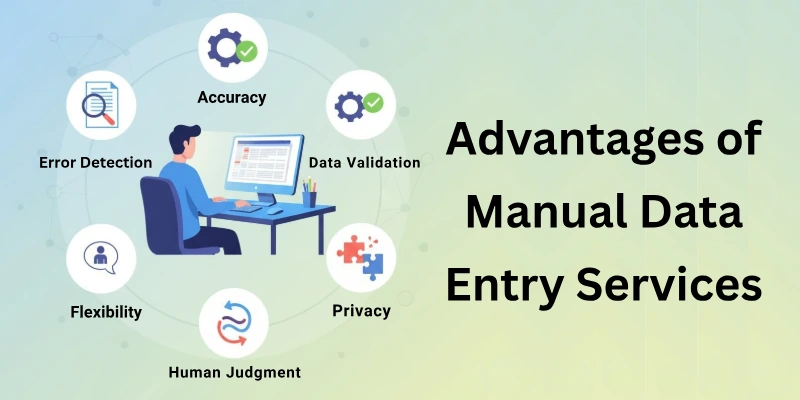
To understand how important they are in today’s data-driven world, let’s look at the benefits of manual data entry services.
- Accuracy and Quality Control
- Flexibility and Adaptability
- Human Judgment and Common Sense
- Job Creation and Economic Benefits
- Data Security and Privacy
Let’s delve into each of these advantages in detail.
1. Accuracy and Quality Control
- Human precision reduces mistakes and ensures accurate data entry.
- A lot of quality control checks make sure that the final dataset is very accurate.
- By checking by hand, mistakes that automated systems might miss are caught.
2. Flexibility and Adaptability
- Different data formats and layouts are easy for manual entry services to handle.
- Variations and special cases are handled well by human operators.
- Being flexible lets you process different kinds of datasets without any problems.
3. Human Judgment and Common Sense
- Skilled operators use their own judgement to figure out what unclear or complicated data means.
- People use their common sense to fix problems that automated systems might miss.
- Having people involved improves the quality of the data as a whole by allowing for deeper decisions.
4. Job Creation and Economic Benefits
- Hands-on data entry services encourage economic growth by creating jobs.
- Companies that outsource these tasks can focus on their main tasks, which makes them more productive.
- Higher employment rates are good for communities’ overall economic health.
5. Data Security and Privacy
- The risk of data breaches that come with automated systems is lower when data is entered by hand.
- Trusted people directly handle sensitive data, which makes it safer.
- Strict protocols for privacy protect data and make sure that regulations are followed.
Disadvantages of Manual Data Entry Services
While manual data entry services offer certain advantages, they come with inherent disadvantages that businesses need to consider. These drawbacks include:
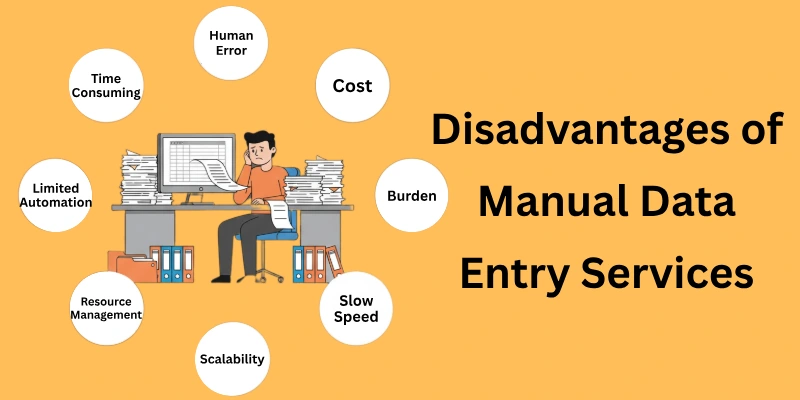
- Human Error and Inconsistency
- Slow Speed and Scalability
- Cost and Resource Management
- Limited Automation Potential
And understanding these drawbacks is crucial for making informed decisions regarding the use of manual data entry services. So, let’s cover the disadvantages of manual data entry services in detail.
1. Human Error and Inconsistency
- Human operators may make mistakes when entering data, which can lead to errors.
- Different people may interpret or follow guidelines in different ways, which can lead to inconsistencies.
- When you do things by hand, you can get tired, which can affect how reliable the data is overall.
2. Slow Speed and Scalability
- In general, entering data by hand takes longer than using a computer.
- It may be hard to scale up operations, which can slow down processing times.
- Dependence on human speed can slow things down, especially when dealing with large datasets.
3. Cost and Resource Management
- Labor-intensive manual data entry services can make running a business more expensive.
- Using resources for manual tasks could put a strain on budgets and make businesses less profitable.
- Costs of hiring and training human operators can be hard for businesses to balance.
4. Limited Automation Potential
- Manual data entry services can’t fully automate tasks that are done over and over or are hard to do.
- There are limited chances to improve efficiency and streamline work processes through automation.
- People are still dependent on manual labour, which makes it harder to get the full benefits of automated systems in data processing.
Conclusion
In this guide, we have covered the advantages and disadvantages of manual data entry services to help you understand where they fit in today’s data-driven world. Manual data entry offers accuracy, flexibility, and the benefit of human judgment, but it can also be time-consuming and less efficient for large volumes of data.
From my experience, I recommend using manual data entry when your project requires careful attention to detail or involves complex information. However, for repetitive or bulk data tasks, blending manual and automated methods gives the best results.
FAQs
Here are some of the most commonly asked questions related to the advantages and disadvantages of manual data entry services:
While automation can be very fast, manual data entry allows for human oversight and judgment, potentially leading to higher accuracy for complex data or tasks requiring context.
Manual entry can be slow and prone to human error, especially with large data volumes. Additionally, scaling up manual teams can be challenging and expensive.
Manual entry is ideal for situations requiring high accuracy with complex data formats, like handwritten documents or audio recordings. It’s also useful when data needs human judgment for tasks like categorization or validation.
In some cases, manual data entry can offer enhanced security, particularly for sensitive information. Manual processes can be less vulnerable to certain cyberattacks compared to automated systems.
While automation is powerful, it’s unlikely to completely replace manual data entry. The future likely lies in a hybrid approach, combining automation for routine tasks with human expertise for complex scenarios.





- Be Respectful
- Stay Relevant
- Stay Positive
- True Feedback
- Encourage Discussion
- Avoid Spamming
- No Fake News
- Don't Copy-Paste
- No Personal Attacks
- Be Respectful
- Stay Relevant
- Stay Positive
- True Feedback
- Encourage Discussion
- Avoid Spamming
- No Fake News
- Don't Copy-Paste
- No Personal Attacks
