Shopify Pros and Cons: Best Platform for Your Store?
Published: 23 Nov 2025
Considering launching an online store but unsure if Shopify is the right platform for you?
But, before choosing an e-commerce option, you should carefully look at what its pros and cons are.
In this blogpost, we’ll delve into the advantages and disadvantages of Shopify, providing a clear picture of what this popular platform can offer your business.
Advantages of Shopify
Shopify has a wealth of benefits that can help you optimize your e-commerce experience and grow your business.
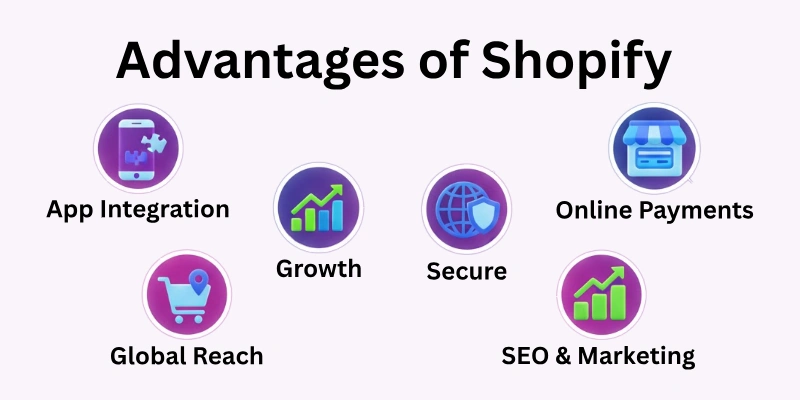
Here are the major pros of shopify:
- Ease to Use
- Customization
- Shopify Payments
- Variety of Themes
- Shopify App Store
- SEO & Marketing
- Hosting & Security
- 24/7 Customer Support
- Mobile Responsiveness
- Scalability and Growth Opportunities
Let us cover each benefit of shopify in detail.
1. Ease to Use
Shopify is renowned for its user-friendly interface. Unlike some platforms requiring coding knowledge, Shopify allows anyone to set up and manage their store with a drag-and-drop builder. This eliminates the need for complex technical expertise, making it ideal for beginners.
Stat: Over 1.7 million businesses worldwide use Shopify for its simplicity and effectiveness.
2. Customization
While Shopify offers a variety of pre-designed themes, you can still personalize your store’s look and feel. You can customize colors, fonts, layouts, and even add custom code for a unique brand experience.
Stat: Shopify offers over 70 customizable themes to suit various industries and preferences.
3. Shopify Payments
Shopify Payments is a built-in payment gateway that allows customers to pay directly through your store. This simplifies the setup process and eliminates the need for third-party connections (though other payment options are available).
Stat: Shopify Payments processes over $200 billion in transaction volume annually, showcasing its reliability.
4. Variety of Themes
Shopify has a large selection of free and premium themes suited for various industries and designs. These pre-built templates are an excellent starting point and may be altered to match your company identity.
With over 70 free themes and thousands of paid options, you’re sure to find a theme that suits your needs.
5. Shopify App Store
The Shopify App Store is a marketplace with thousands of apps and integrations to help you expand the functionality of your store. There is an app for practically every area of running an internet business, including marketing and sales tools, inventory management, and customer care.
Stat: The Shopify App Store hosts over 6,000 apps, with new ones added regularly.
6. SEO & Marketing
Shopify has built-in SEO (Search Engine Optimization) features that will help your store rank higher in search engine results. They also provide marketing solutions such as email marketing and social media connections to help you reach new customers.
Stat: Some say that Shopify SEO services can increase traffic by as much as 450%, and others have seen year-over-year traffic growth of 65%.
7. Hosting & Security
With Shopify, you don’t have to worry about hosting or security for your online business. Shopify hosts your website on secure servers and manages all security concerns, such as SSL encryption, PCI compliance, and frequent threat protection updates and patches.
Stat: Shopify maintains a 99.99% uptime and offers Level 1 PCI DSS compliance.
8. 24/7 Customer Support
Shopify provides 24-hour customer service by phone, email, and live chat, regardless of your time zone. This assures that you can always get support if you have a problem.
Stat: Shopify’s customer support team resolves over 800,000 inquiries per month with an average response time of less than 5 minutes.
9. Mobile Responsiveness
Shopify themes are mobile-responsive, ensuring that your store appears and works properly across all devices. This enables you to reach and communicate with customers on the go while still providing a consistent buying experience.
Stat: Over 70% of online shopping happens on mobile devices, highlighting the importance of a mobile-friendly storefront.
10. Scalability and Growth Opportunities
Shopify is a flexible platform that can expand alongside your business. Whether you’re just getting started or managing a huge inventory with a high number of sales, Shopify can handle it. They provide various price plans to meet your requirements, allowing you to upgrade as your business grows.
Stat: Over 4,000 businesses on Shopify Plus, Shopify’s enterprise-level platform, have achieved annual revenues exceeding $1 million.
Disadvantages of Shopify
While Shopify offers a compelling solution, it’s important to acknowledge some potential downsides.
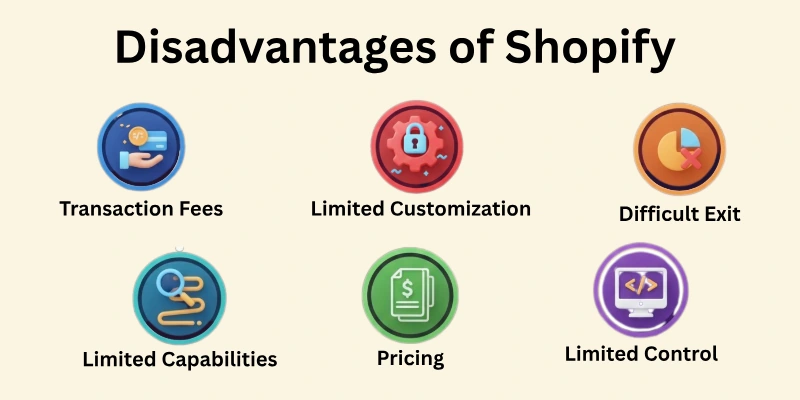
So here are some major cons of shopify:
- Pricing
- Limited Design Customization Options
- Limited Blogging Capabilities
- Limited Control Over Hosting
- Shopify Processing Fees
- No Email Hosting
- Difficult Exit
Let us cover all the limitations of using shopify.
1. Pricing
Shopify’s monthly prices range between $29 and $299, with additional transaction fees if you don’t use their built-in payment gateway (Shopify Payments). For new businesses, these costs can add up, especially if you’re on a tight budget.
2. Limited Design Customization Options
Shopify lets you change the look of your themes, but if you want to make major modifications to the design, you might need to know how to code or hire a developer. This can limit your ability to achieve a completely unique storefront experience.
3. Limited Blogging Capabilities
While Shopify does include a built-in blogging platform, it may not offer the same level of functionality or customization as dedicated blogging platforms like WordPress, which could be a drawback for businesses that rely heavily on content marketing.
4. Limited Control Over Hosting
Shopify hosts your store, which is convenient, but it gives you less control over the server environment. This may be a worry for companies that want a high level of flexibility or wish to integrate unique server-side functionalities.
5. Shopify Processing Fees
If you choose not to use Shopify Payments, you will be charged transaction fees for each sale made through a third-party payment gateway. These fees might reduce your profits, so consider them into your cost calculations.
6. No Email Hosting
Unlike some other e-commerce systems, Shopify does not provide email hosting services. So users must set up email accounts through third-party providers, which complicates communication channel management.
7. Difficult Exit
Migrating from Shopify to another platform might be difficult due to Shopify’s specialized architecture and data structure. Users may have difficulty exporting data and transferring easily to a new platform, perhaps resulting in downtime and data migration concerns.
Conclusion
So, guys, in this article, we’ve covered the pros and cons of Shopify in detail. We explored the advantages, like the user-friendly interface and extensive app store, with some potential drawbacks, like pricing plans and limited design control, to consider when making your decision.
Ultimately, the best platform for you depends on your specific needs and budget. Shopify is a powerful platform that can help you build and expand an online store.
But if you’re still unsure, they offer a free trial so you can test-drive the platform and see if it’s a good fit for you or not.
FAQs
Here are some of the most commonly asked questions related to the advantages and disadvantages of shopify:
Absolutely! Shopify’s drag-and-drop interface and user-friendly setup make it ideal for entrepreneurs with no coding experience.
Yes, you can customize your store’s appearance with a variety of themes and some layout tweaks. However, extensive design changes might require a developer’s help.
Shopify prioritizes security. Their built-in payment gateway, Shopify Payments, offers a secure way to accept payments. You can also integrate other payment gateways.
Shopify can grow with your business because it is a flexible tool. They have pricing plans for businesses of all kinds, and you can upgrade as your business grows.
While Shopify’s pricing is clear, there can be additional transaction fees if you don’t use Shopify Payments and you might need separate services for email marketing and advanced blogging.
Moving your store from Shopify to another platform is possible, but it can be hard to do and take a lot of time. When picking a platform, you should think about your long-term goals.





- Be Respectful
- Stay Relevant
- Stay Positive
- True Feedback
- Encourage Discussion
- Avoid Spamming
- No Fake News
- Don't Copy-Paste
- No Personal Attacks
- Be Respectful
- Stay Relevant
- Stay Positive
- True Feedback
- Encourage Discussion
- Avoid Spamming
- No Fake News
- Don't Copy-Paste
- No Personal Attacks
