Pros and Cons of E-book: Benefits vs Limitations
Published: 2 Feb 2026
The world of books is changing quickly because of technology. There are now more than a million ebooks on the market, so e-readers are common in bags and on trains.
This huge rise in fame makes me wonder if ebooks are a good replacement for traditional books.
To answer this question I have come up with a list of all the advantages and disadvantages of ebooks, exploring their convenience, affordability, and unique features. While also considering the drawbacks of digital reading and the irreplaceable charm of physical books.
Guys, before diving into the article, let me clarify the concept between paper books and ebooks.
E-Books vs. Print Books
There are two different ways to read: typical print books and their digital versions, called e-books. Print books, those familiar bound volumes with clean pages and a nice weight in your hand, have been with people for hundreds of years. E-books, on the other hand, are digital files that can be read on electronic devices like tablets, smartphones, or dedicated e-readers.
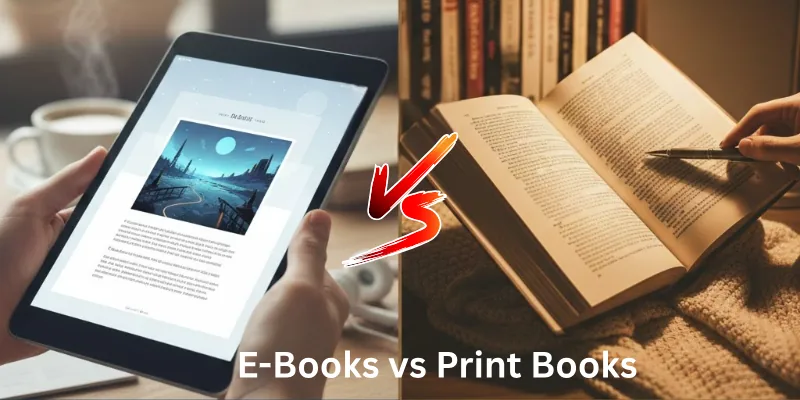
But as the technology is updating, the trend of e-books is also emerging, so the next part of this article will cover the pros and cons of ebooks in detail.
Advantages of E-Books
E-books offer a multitude of benefits for readers in today’s digital age. Here’s a look at some of the key advantages of electronic books:
- Portability
- Convenience
- Affordability
- Search Functionality
- Adjustable Font Size and Style
- Built-in Dictionary
- Integrated Note-Taking
- Wider Selection
- Environmentally Friendly
- Accessibility Features
- Interactive Elements
Let’s cover all the above mentioned pros of ebooks in detail.
1. Portability
You no longer have to carry around big books in your bag. Because e-readers and tablets are so small and light, you can carry a huge library with you. You can have all of your reading material on one device, so you can easily access it while you’re commuting, flying, or just relaxing on the couch.
2. Convenience
E-books are the most convenient way to read. With e-books, you can get the book you want right away and start reading it. There are no longer lines or shop hours that limit your access to a vast world of books. You can access them at any time, day or night.
3. Affordability
Some people find that e-books are cheaper than paper copies. E-books are often cheaper, especially for older or out-of-print works. A lot of online stores also have sales and discounts on e-books all the time, so you can find great deals on your best books.
4. Search Functionality
When you use an e-book instead of a paper book, you can instantly search for particular information within the text. This is very helpful for students, researchers, and anyone else who needs to find a passage or reference fast.
5. Adjustable Font Size and Style
E-books let you customize your reading experience to make it as comfortable as possible. You can make the settings easier on your eyes and improve the flow of your reading by changing the font size and style. This is especially helpful for people who have trouble seeing or who just like different font sizes.
6. Built-in Dictionary
No more interrupting your reading to grab a separate dictionary! E-books often come with built-in dictionaries, allowing you to look up unfamiliar words with a simple tap or click. This helps you understand the writing better without taking your attention away from it.
7. Integrated Note-Taking
E-readers and many e-book apps offer note-taking features. You can highlight passages, write down your thoughts and ideas, and create bookmarks for future reference. This is a valuable tool for students, researchers, or anyone who wants to engage actively with the text and retain key points.
8. Wider Selection
E-books often boast a wider selection compared to physical bookstores. Some titles, especially niche or out-of-print books, may not be available in stores because they don’t have enough shelf room. E-book platforms, on the other hand, can give a huge selection because they don’t have to worry about physical storage. It’s more likely that you’ll find the exact book you want, no matter how old or famous it is.
9. Environmentally Friendly
When it comes to reading, e-books are a better choice. By choosing digital copies, you lower the need for paper production, which can have a big effect on cutting down trees and using up resources. Many readers who are worried about how traditional book printing affects the environment will like this benefit.
10. Accessibility Features
E-books are good for more people because they have many features that make them easy to access. Text-to-speech conversion choices can be one of these. This lets users hear the book read out loud. Also, features like color themes, and connection with screen readers can be very helpful for readers who have trouble seeing or learning.
11. Interactive Elements
Even though the main experience is still text-based, some e-books have engaging parts that make reading more fun. Some examples are audio clips, videos, and even links that take you to more information or tools. This interactive approach can be particularly engaging for educational materials and children’s books.
Disadvantages of E-Books
While e-books offer a lot of advantages, it’s important to acknowledge the potential drawbacks as well.
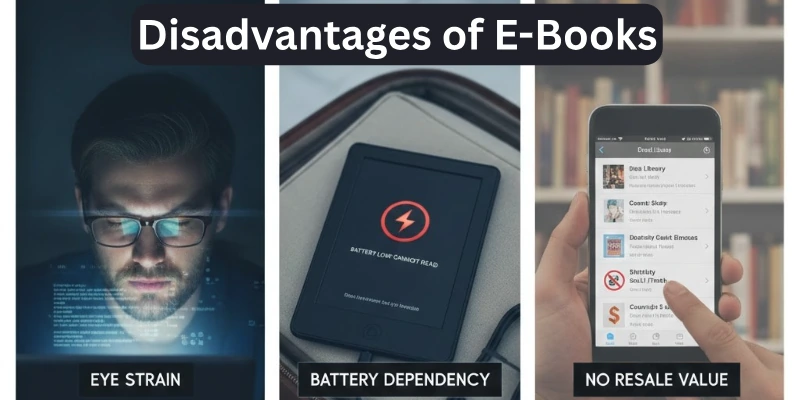
Here’s a list of some key disadvantages of electronic books to consider:
- Eye Strain and Screen Fatigue
- Limited Tactile Experience
- Potential Battery Drain
- Device Dependence
- Borrowing and Lending Difficulties
- Resale Limitations
- Security Concerns
Let us cover all the above mentioned cons of ebooks in detail.
1. Eye Strain and Screen Fatigue
Staring at a digital screen for an extended period of time can cause eye strain and tiredness. Unlike printed books that use reflected light, e-readers and tablets emit blue light, which can disrupt sleep patterns and contribute to dry, irritated eyes. So, taking regular pauses and lowering screen brightness is necessary.
2. Limited Tactile Experience
For many book lovers, the physical experience of holding a book, turning crisp pages, and feeling the texture of the paper are all important parts of reading. E-books lack this sensory element, which some readers may find a significant drawback.
3. Potential Battery Drain
Most e-readers say their batteries last a long time, but reading for a long time or using features like brightness can drain the battery. This could be a problem, especially if you’re elsewhere and can’t plug in your device.
4. Device Dependence
E-books require a specific device to be read. Whether it’s an e-reader, tablet, or smartphone, you’re reliant on the functionality of that device. This can be a disadvantage compared to print books, which can be read anywhere, anytime, without needing a separate device.
5. Borrowing and Lending Difficulties
Sharing electronic books can be harder than lending a real book. Lending features are available on some e-book sites, but they usually come with rules or restrictions. Unfortunately, this can be a problem for readers who like to share their favorite books with family and friends.
6. Resale Limitations
Unlike traditional books, which can be sold or donated, e-books are usually licensed for personal use. This means you can’t resell them after buying them, which can be a drawback for individuals who wish to trade in or regain some of the cost of their books.
7. Security Concerns
If you download e-books from unknown sources or sharing files, they might have malware or viruses that could make your device less safe. Stick to e-book stores and sites with a good reputation to keep your device and personal information safe.
E-Books Facts
- The concept of an e-book dates back to the 1930s, with visionary engineer Engelbart describing a “machine that would display any page of a book” in his writings.
- The first commercially available e-reader, the “Model 100,” was released by RCA in 1971 but lacked the processing power to display text effectively.
- Project Gutenberg, launched in 1971, is the oldest digital library and made history by offering free e-books of classic literature.
- In 1998, the release of the Palm Pilot with its e-reader software signaled a renewed interest in portable digital reading devices.
- The release of the Sony Reader in 2006 is considered a landmark moment, marking the first mass-market e-reader with a user-friendly design.
- Amazon’s Kindle, launched in 2007, revolutionized the e-book market with its vast library, innovative features, and competitive pricing.
- In 2010, e-book sales surpassed hardcover sales for the first time in the United States, signifying a major shift in reading habits.
- The rise of e-books has led to the preservation of countless out-of-print books, making them accessible to a wider audience.
- Self-publishing has become significantly easier with e-books, allowing new authors to bypass traditional gatekeepers and reach readers directly.
- E-books continue to evolve, with features like text-to-speech, interactive elements, and integration with audiobooks enhancing the reading experience.
Conclusion
So, guys, in this article, we have covered the pros and cons of ebooks in detail. We have seen how these electronic books are helpful for us and how they create convenience in our lives. However, if you are a book lover, obviously ebooks do not hold any special importance for you.
But yes, before making any decision, do keep in mind all the advantages and disadvantages mentioned above.
FAQs
Here are some of the most commonly asked questions related to the advantages and disadvantages of ebooks:
Disadvantages of e-books for children are:
- Screen Time
- Limited Interaction
- Distractions
Advantages of books:
- Physical Experience
- Focus and Retention
- Durability
Disadvantages of books:
- Limited Portability
- Storage Space
- Availability
Disadvantages of of digital libraries are:
- Limited Access
- Technical Issues
- Distractions
- Copyright Issues
- Lack of Physical Copies
Disadvantages of digital apps are:
- Distractions
- Cost
- Privacy Concerns
- Security Risks
- Screen Time
Disadvantages of digital communication are:
- Misunderstandings
- Lack of Personal Connection
- Information Overload
- Addiction
- Social Isolation



- Be Respectful
- Stay Relevant
- Stay Positive
- True Feedback
- Encourage Discussion
- Avoid Spamming
- No Fake News
- Don't Copy-Paste
- No Personal Attacks
- Be Respectful
- Stay Relevant
- Stay Positive
- True Feedback
- Encourage Discussion
- Avoid Spamming
- No Fake News
- Don't Copy-Paste
- No Personal Attacks
